
Map Your Client Journey: 5 Steps for Service Success
Client Journey, Small Business Systems
Map Your Client Journey Fast: A 5‑Step Guide for Service Businesses
Stop hiring chaos! Learn 5 simple steps to map your client journey, fix process problems, and scale your service business without burnout. Avoid the most expensive mistakes.
Why Client Journey Mapping Solves Your Biggest Process Problems
If you run a service business, you already know what a small business process problem feels like: missed emails, double bookings, clients asking the same questions, and work that depends on you remembering every tiny detail. That chaos is not a people problem; it is a journey problem. Clear client journey mapping turns confusion into a repeatable system you can delegate and eventually automate.
This map-client-journey-fast-guide is designed to help you capture your entire client experience in under a day, then use it to automate business processes, improve SEO and AEO, and support schema optimization so ideal clients can actually find and understand your services online.
Step 1: List Every Stage of Your Client Journey
Start with a simple, end‑to‑end flow. For most service businesses, the five core stages are:
Inquiry – the moment someone discovers you and reaches out
Quote – you clarify needs and present pricing or a proposal
Booking – contracts, payments, and scheduling are confirmed
Delivery – you do the work and communicate progress
Follow‑up – feedback, testimonials, referrals, and repeat offers
💡 Pro Tip: Use the alternative image description in your media library for accessibility and SEO: “An INSERVICE branded graphic showing a simplified 5-step client journey with arrows connecting inquiry, quote, booking, delivery, and follow-up, emphasizing process mapping for small businesses.”
Step 2: Capture Actions, Tools, and Owners at Each Step
For every stage, list three things: what happens, which tool you use, and who owns it. For example, at “Inquiry” you might capture: website contact form, auto‑reply email, and CRM tag. This instantly reveals where tasks are stuck in your head or scattered across tools, so you can fix process problems before they cost you clients.
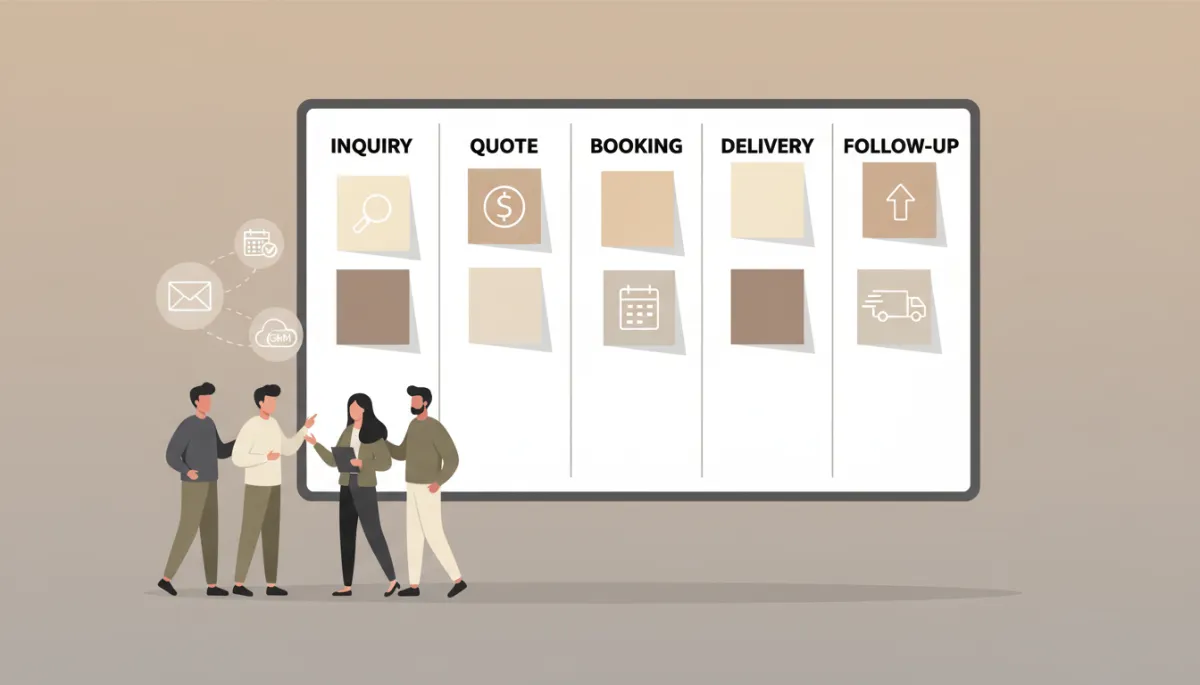
Visualizing each stage exposes hidden bottlenecks and repeatable tasks you can automate.
Step 3: Identify Friction Points and Expensive Mistakes
Now highlight where leads or clients fall through the cracks. Common friction points include slow responses, unclear next steps, manual invoicing, or no follow‑up. These are the spots that create the most expensive mistakes: lost leads, scope creep, refunds, and negative reviews. Mark them clearly; they are your highest‑value improvement opportunities.
📌 Key Takeaway: The goal is not perfection. It is to see where your current journey is leaking money and energy, so you can plug those gaps before you scale.
Step 4: Automate Business Processes That Repeat
Once the journey is mapped, circle every task that happens the same way for most clients. These are your candidates to automate business processes: intake forms, calendar booking, reminder emails, invoice triggers, feedback surveys, and review requests. Even simple automation frees hours each week and makes it far easier to scale your service business without burnout.
Automation does not replace your personal touch; it protects it by handling the repetitive, timing‑sensitive tasks that humans constantly forget when they are busy.
Step 5: Align Your Journey with SEO, AEO, and Schema Optimization
A mapped journey also makes your marketing smarter. With SEO, you can create pages and blog posts that match each stage: discovery content for “Inquiry,” pricing FAQs for “Quote,” onboarding guides for “Booking,” and case studies for “Delivery” and “Follow‑up.” Use your core terms—like small business process problem, client journey mapping, and automate business processes—in headings, meta descriptions, and internal links to signal relevance to search engines.
For AEO (answer engine optimization), structure content around specific questions clients ask at each stage, then give clear, concise answers that can be pulled into featured snippets or voice search responses. Schema optimization ties it all together: use structured data (such as LocalBusiness, Service, FAQPage, and Review schema) so search engines can interpret your services, locations, and social proof in a machine‑readable way. When your journey, content, and schema match, you avoid the most expensive mistakes—like driving traffic to pages that do not convert or confusing both humans and algorithms about what you actually offer.
From Chaos to Clarity: Your Next Best Move
When you follow these 5 simple steps to map your client journey, you turn invisible chaos into a visible system you can refine, delegate, and automate. You fix process problems at the root, support SEO, AEO, and schema optimization, and create a smoother experience for every new client who finds you. That is how you scale your service business without burnout—and finally stop paying for the same avoidable mistakes over and over again.